
Scope it Out: Scope, Goals, and the Art of Not Losing Your Damn Mind
- Toni Federico

- Nov 3, 2025
- 6 min read

The very first course I ever created was about diamonds. I was working for a prominent diamond importer in the DC Metro area, running the insurance replacement division. If you lost a diamond, we helped you replace it. I was a Diamonds Graduate of the Gemological Institute of America, so I was an expert in diamonds.
All I had to do was train State Farm property adjusters on how to read diamond certificates. Simple. Right?
I thought, “Piece of cake! I know this stuff like the back of my hand.” What I thought would be a weekend project ballooned into a month of endless iterations, anxiety attacks, and caffeine-fueled self-doubt. My coffee budget exploded.
Why? Because I never defined the scope, and I ignored my goal.
When “Just One More Idea” Becomes a Monster
Scope creep is sneaky. In courses, it sounds like:
“I’ll just add a few bonus lessons.”
“What if I also include a workbook? And maybe a paid community?”
Suddenly, your “simple class” has become a beast.
Think of scope as the guard rails. Think of goals as the destination. Without both, your course is like a map with no edges and no finish line. You’ll keep wandering, adding, tweaking, and re-recording until you’re too tired to finish.
And for creatives, boundaries can feel like cages. But in project management, scope is more like a canvas’s frame — it doesn’t stifle the art; it holds it together.
When you decide that your course will be six modules, not sixty, you’re giving yourself a shape to paint within. When you set a clear goal, you’re letting your brain know what the finish line looks like so you recognize it when you get there.
Goals: The Finish Line You Can Actually Reach
A goal isn’t “make a course.” That’s too vague. A real goal is: “Launch a four-week beginner watercolor course where students complete one finished piece by the end.”
That’s clear. That’s measurable. That’s finishable.
Your goal gives your course direction, energy, and an endpoint. Without it, you’re just wandering around in the creative wilderness, trying to turn every idea into a lesson, or a workbook, or a blog article … you get the idea.
A Real Example: The Overachieving Designer
I teach a class on designing effective logos using the ARMM method pioneered by William Lidwell. The first time I taught this course, it was a four-hour in-person workshop. The way I had designed the course was too much for me to teach, and it was too much for my students to absorb. Why? Because I didn’t scope the course. I tried to cover way too much material, and it was a horrible experience for everyone.
After that absolute trainwreck of a workshop, one of my students came up to me and said, “You know, I really just wanted to know how to ensure my logo was effective so I didn’t have to redesign it for a few years. I didn’t really need all that other stuff. But it was nice to meet you.”
I made it to my car before I ugly cried into my steering wheel. That was precisely what I had planned to teach when I first started, and then I let all the ideas get the better of me. Instead of offering a really valuable course to small business owners, I ended up wasting everyone’s time, including my own.
I gave myself the weekend to eat a lot of Breyer’s Mint Chocolate Chip ice cream and wallow, and then I set about redesigning the entire course. The very first thing I did was define the scope.
The scope I defined was: “A one-hour workshop on how to use the ARMM method for logo design for small business owners, along with a complimentary workbook that explains the four elements of ARMM and offers two reflection exercises.”
Here’s what most people forget about defining scope: the deliverables. Remember, your goals are “why” you’re doing something, and your scope is the “what.” But, part of that “what” is who it’s for, your ICA, which we’ll cover next month, and lastly, the deliverables. These four pieces collectively equal the scope. Let’s break it down visually…
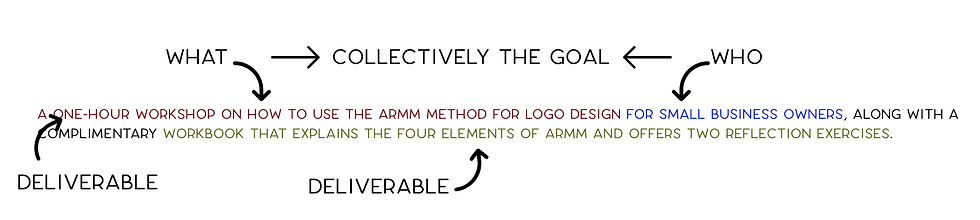
With a simple one-sentence scope statement, my workshop went from a disaster that left me crying to a course that is focused, teachable, and achievable. Using that simple scope statement, I defined my deliverable as follows:
One-hour workshop encompassing the following topics:
What equals a brand
ARMM
Color Science
How to hire a designer
Workbook
Brand Brief
2 Reflection Exercises
ARMM with one page per component
Page for notes for each component
Tip sheet for working with a designer
Do you see how focused my class became with that one simple shift? On top of that, I know exactly what to create. The result, I’ve successfully taught my redesigned workshop for the last 10 years and will again later this year.
Why Scope Matters?
Do you remember last month when I talked about the mental and emotional load of treating a project like a task? The same holds true here. When you define your scope, you trade overwhelm for order by specifying what’s included and what’s not, which is creatively freeing. You can now focus on what you’ve defined as your deliverables and let all the rest go. Your scope statement gives you permission to say no (or to charge for changes if a client wants something outside of scope).
Case in point: I get hired a lot by small-business mentorship organizations (think SBA, SCORE, etc.), and they sometimes ask if I can do logo critiques for attendees at the end of the session. My answer: nope, not in scope. Or, it’s “I’m happy to offer that at a fee for attendees” if I’m feeling generous. The one thing I no longer do, however, is agonize about the choice.
How to Set Scope and Goals Like a Pro (Without Killing Your Creativity)
Here’s your crash course in framing your canvas:
Start with your audience and the desired outcome.
What transformation will your students walk away with? Be specific.
“Feel more confident drawing portraits” is vague. “Draw a realistic self-portrait in charcoal by week four” is concrete.
Define your boundaries.
How many modules? How many lessons per module?
How much live interaction vs. self-paced work?
Define your deliverables
To workbook or not to workbook
Include blog posts and promotion in these decisions
Make these decisions early — and write them down. Sticky notes count.
Cut without guilt.
Every new idea (“What if I add a bonus lesson on shading?”) should be measured against your original scope.
If it doesn’t fit, it’s not for this course. Maybe it belongs in your next one.
Anchor your goals in reality.
Ask: Can my students achieve this in the time frame I’ve set?
Can I create this without sacrificing sleep, sanity, or snacks? If not, trim. (And maybe grab a snack anyway.)
Boundaries Set You Free
Here’s the irony: boundaries set you free.
When you know the shape of your course, you can pour your creativity into what fits inside instead of exhausting yourself trying to fill an infinite void. Your course doesn’t need to contain everything you know. It needs to carry your students from here to there.
That journey needs a path, not a labyrinth.
So next time you start building a course, remember: Scope is your frame. Goals are your compass.
And when you’ve got both? You can finally manifest that finished course — without losing your damn mind.
Take Action: Grab the Scope It Out worksheet and define your course boundaries before it defines your stress level.
Janet “Toni” Federico, PMP, MBA, MFA, is an illustrator, surface designer, writer, and curriculum designer from Washington, DC, now based in the Midwest. Toni helps online course creators optimize their content to ensure students learn what is being taught. Toni’s courses have been used by the State of Texas, major insurance companies, and in her own work as a teaching artist. Are you an online course creator looking to optimize your courses to set your students up for success? Get Toni in your inbox.
